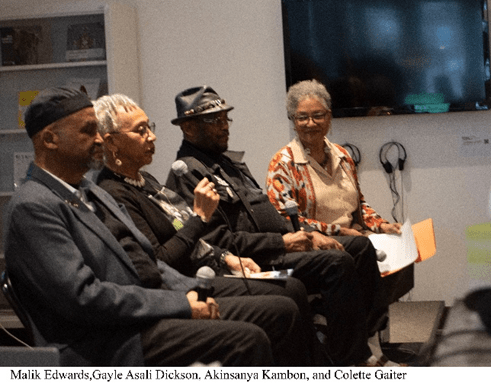
Former members of the Black Panther Party showcased their diverse artistic media at the Rowan University Art Gallery. On Saturday, February 8, the Rowan Art Gallery hosted a panel of four artists with ties to the Black Panther Party, including Akinsanya Kambon, Gayle Asali Dickson, Malik Edwards, and Emory Douglas, who joined via Zoom.
The artists roamed around their respective displays and mingled with the attendees, largely discussing their artwork and how their association with the Black Panthers had influenced their perspective on the world and then interpreted that vision through their unique styles. The event was a raging success—it honestly couldn’t have gone better. When the artists took their seats at the front of the gallery, the tone of the room shifted from hushed to silent.
All four extraordinary, young-at-heart artists spoke about their lives through the lens of dedication to making a change. They discussed their experiences in the military, particularly during the Vietnam War. They reflected on their time spent with the Black Panther Party and how it helped shape them into the well-rounded people they are today. Whatever preconceived notions the attendees had, they probably weren’t expecting a history lesson—and a fascinating one at that.
The United States’ school system tends to wash over the era of the Black Panthers, making them out to be radical troublemakers. But that could not be further from the truth, according to the artists in question. These mavericks discussed the positive influence the organization had on their communities. For example, we learned that if it weren’t for the Black Panthers, we wouldn’t have free breakfasts and lunches at elementary and middle schools for students in need. Whatever their political ideology may have been at the time, these artists/activists worked hard to make a difference in their communities; their dedication and compassion permeated the space.
Each of the artists started out with not-so-simple pencil drawings. Mr. Kambon, for one, started drawing 74 years ago. He began creating art at a very young age as a therapeutic response to the people who were mean to him during his formative years. “I’ve been drawing since I was knee-high to a grasshopper,” says Ms. Dickson. Mr. Edwards’s style has since evolved into creating AI images, but he maintains that the color pencil is by far his favorite instrument.
Mary Salvante, the director and chief curator of the gallery, collaborated on this exhibition with Colette Gaiter, a University of Delaware professor emerita of African studies, as well as art and design. The two had worked together several times before, and their conversations morphed into a four-artist panel. Mr. Edwards explained, “You go through different phases of whatever art is, and you just play with it, see what you come up with.” Ms. Dickson let me in on a little secret: it doesn’t have to be a masterpiece to be considered art. Stick figures are art. Your signature is art. Playing the piano, photography, and clay modeling are all forms of art. So, go on—get out there, and play with your art. You never know what will become of it until you try.
 Media by Scibilia